
An online tool from WatchMeGrow

The Development Map shows young children’s learning and progress in a holistic way so that practitioners, teachers, parents and carers can see the ‘whole child’ and understand the complex nature of their development and progress from birth to 6 yrs old.  There are so many ways you can use the Development Map it is probably best described as a ‘pedagogical tool’ which brings together good practice based on child development; as well as supporting the professional development of observation skills and ensuring that we think about children’s progress in a child-centred way.

 ‘Children are thrilled and grateful when adults want first to understand them and then to help them’ (Loris Malaguzzi 1920-1994)

Get Started with the Development Map

Check our subscription prices

Development Map
The Development Map

Building on Malaguzzi’s wise words the Development Map makes us think more deeply, as well as asking more informed questions about children’s development and learning.  The Development Map is a collaborative tool which supports positive relationships between the child, the family and the setting/school; through good communication, sharing the child’s learning, progress and building authentic partnerships.

We have had some great feedback from our Development Map partners 

‘Our parents love the Development Maps. We talk about them together and they are now showing a greater interest and understanding of their child’s progress’. Teacher, Nursery School and Children’s Centre, London

‘It’s great as you can see progress in a positive way even though it may not be much – so good for parents.’ Reception Class Teacher, Cumbria

‘An interesting way of visualising children’s development and progress – I can still see the child’. EYT Private Nursery, Leeds

‘It’s so much easier to pinpoint where the gaps are – really clear in the circle’. Childminder, Surrey

‘Now I am using the Development Map to share every learning story we do at home and I can ask any questions. The Development Map made it easier for parents and teachers to communicate. Thank You’   Owais’ Mum, Sheffield

Have a look at the Development Map Film below  to see what it looks like in practice.

The Development Map is used to make these summative assessments for learning, it enables you to;

  • Use your informed judgement and knowledge of the child to make a quick summative evaluation of where they are in their developmental journey
  • Look at the child’s development in an holistic way and over time, so that you can see how one area of learning relates to another and also the progress they have made from one summative point to the next
  • Use your observations, learning stories and photographic snap shots to inform the judgements you make and as evidence of the child’s progress
  • Share the child’s learning, development and progress with parents in a clear and straightforward map illustrated with their learning stories
  • Make comparisons and analysis of the data to find out how well your children are progressing e.g. boys and girls, summer born children, SEND, children learning English as an Additional Language (EAL), children who are receiving the Early Years Pupil Premium (EYPP) and other important analytical factors
  • Use an assessment tool which respects the child and views all their learning as contributing to their development and which supports the professional judgement of practitioners
  • Track children’s progress to monitor the quality of provision and practice and inform visits from Ofsted, HMI, LA professionals and other partners. The Development Map can be used as a Quality Improvement Tool.

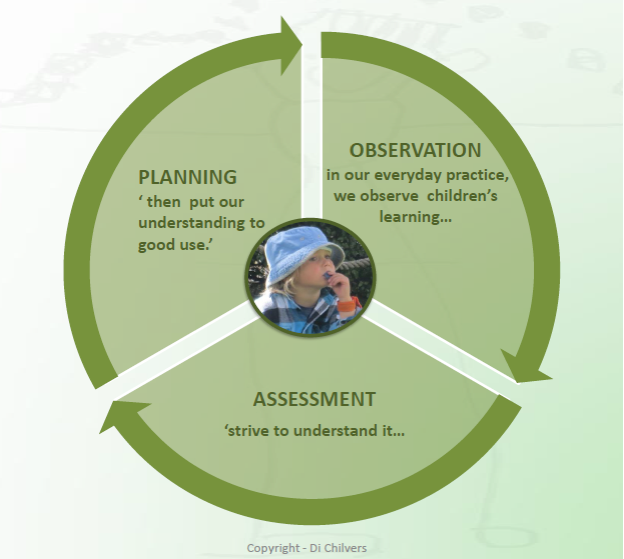
The Development Map Cycle

The Development Map cycle should be very familiar to everyone working in the Early Years Foundation Stage. It starts with observation then moves into assessment and planning and is explained in the EYFS Statutory Framework (2.1 p.13) but more clearly illustrated through the diagram in Development Matters (2012 p.4)

Mary Jane Drummond’s explanation of the cycle is probably one of the best you will ever find – it’s so good that New Zealand practitioners used this as their starting point for developing learning Stories;

‘When we work with young children, when we play and experiment and talk with them, when we watch them and everything they do, we are witnessing a fascinating and inspiring process: we are seeing them learn. As we think about what we see, and try to understand it, we have embarked on the process that in this book I am calling ‘assessment’. I am using the term to describe the ways in which, in our everyday practice, we observe children’s learning, strive to understand it, and then put our understanding to good use’. (1993, p.13)

As a cycle it looks like this……

The Development Map follows these principles and Statutory Duties whilst keeping children at the heart – recognising them as competent and capable thinkers and learners while using assessment processes which are respectful and ethical.

Development map Phase 1 will be available in April 2016. Please register your interest using the form below or contact us at di.chilvers@watchmegrow.uk to stay updated.